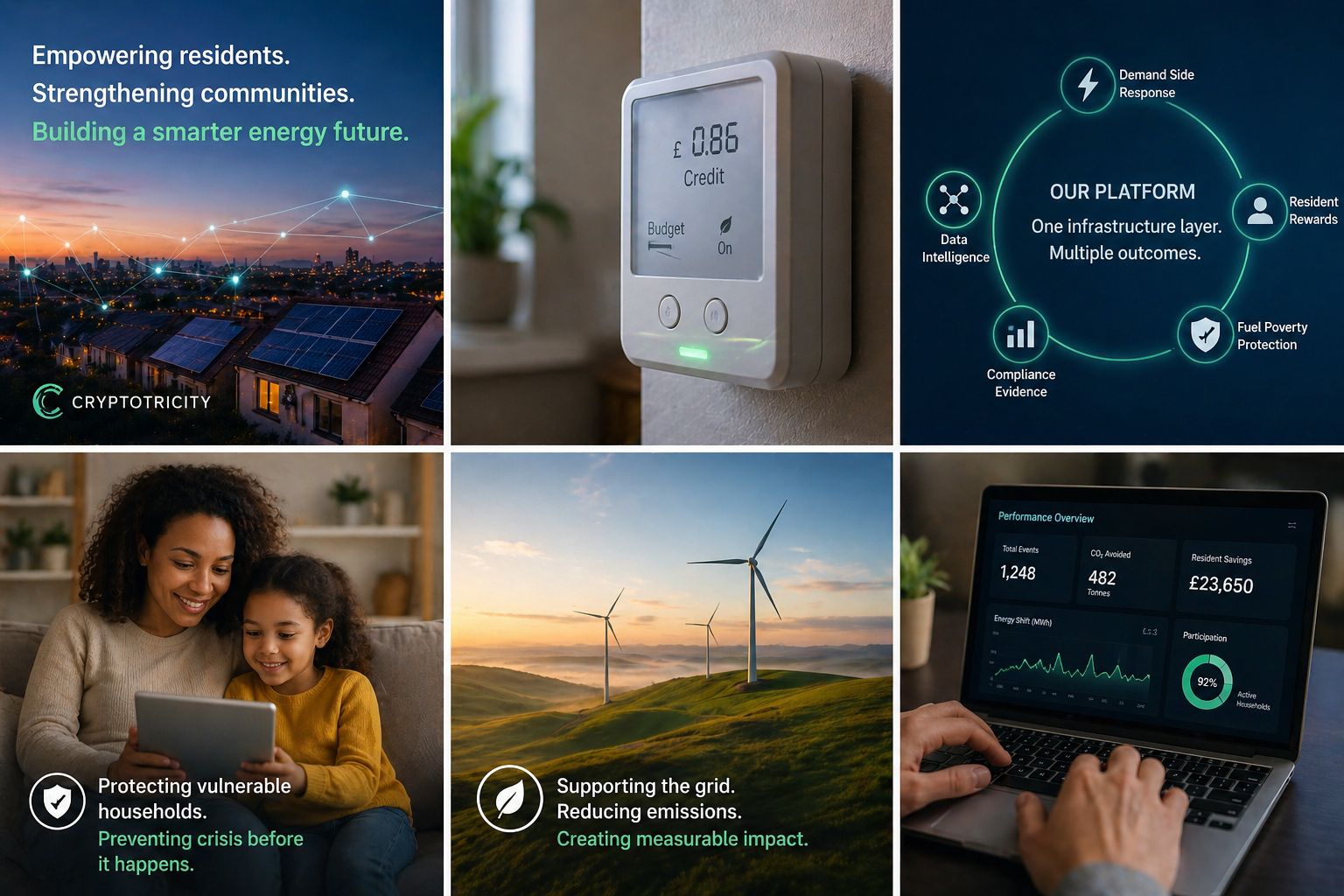
MEES compliance evidence generated automatically
CTYPE html>Resident Energy
Participation Infrastructure
The operational layer that connects smart meter data, Demand Side Response, fuel poverty protection, and MEES compliance evidence — automatically, in one platform, for every home in your portfolio.
Not a dashboard.
Not a loyalty programme.
Operational infrastructure.
Cryptotricity is a resident-energy participation infrastructure platform designed for Housing Associations in England. It connects tenant smart meter participation, Demand Side Response, fuel poverty protection, and evidence generation into a single operational layer — automatically, continuously, and without requiring tenants to understand or interact with any technology beyond a simple screen showing their balance in pounds.
We are the operational infrastructure that makes resident energy participation measurable, evidenced, and financially self-sustaining — for the first time in social housing.

Three pressures.
One platform.
Housing Associations in England are navigating three simultaneous pressures in 2026 — each with significant financial, reputational, and regulatory consequences.
EPC C required across two metrics by October 2030. Fines up to £30,000 per non-compliant property. The smart readiness metric demands evidenced tenant engagement — which most associations cannot currently produce at scale.
Up to £30,000 per propertyClose to one quarter of social housing tenants are in fuel poverty. Cold homes drive NHS admissions, safeguarding referrals, and complaints. Prepayment meter disconnections happen silently at night — vulnerability is discovered too late, after the harm is done.
~25% of tenants affectedThe Warm Homes Social Housing Fund requires evidenced consumption baselines, resident engagement records, and measurable bill savings. Most associations are applying without this infrastructure — weakening bids or disqualifying entirely.
Fund launches March 2027Why existing measures
are not enough.
Most Housing Associations already invest in retrofit programmes, hardship support funds, resident engagement initiatives, and sustainability reporting. The problem is that these systems remain fragmented. Evidence is manual and inconsistent. Vulnerability is discovered reactively — after a crisis, not before it.
Cryptotricity does not replace any of these investments. It creates the connective tissue between them — a single operational layer that makes all of them more evidenced, more measurable, and more fundable.
| ❌ Current Fragmented Process | ✓ Cryptotricity Replaces It With |
|---|---|
| Consultant-led evidence gathering — manual, expensive, periodic | Continuous automated evidence generation — per household, every month |
| Reactive hardship discovery — tenant calls, referrals, arrears flags | Proactive vulnerability detection — Lifeline fires before disconnection occurs |
| Manual retrofit validation — separate surveying, inconsistent methodology | Automated pre/post-retrofit benchmarking — DCC baseline, PAS2035-compatible |
| Weak resident engagement proof — attendance records, surveys | Measurable DSR participation scoring — timestamped, per-household, auditable |
| Disconnected reporting — multiple teams, multiple formats | Single compliance-grade framework — MEES, Warm Homes, PAS2035 in one output |
Why Demand Side Response
changes everything.
DSR is not an add-on feature. It is the mechanism that makes the entire model financially self-sustaining — and the reason the tenant reward costs your organisation nothing.
- Resident incentives must be funded internally from HA welfare budget
- Engagement is passive — difficult to measure or evidence
- Reporting relies on surveys and manual data collection
- Platform is a cost centre with no external revenue offsetting fees
- NESO pays Cryptotricity directly as a registered third-party DFS aggregator
- Cryptotricity converts NESO payments into resident bill credits — zero HA cost
- Every DSR event creates a timestamped participation record automatically
- Resident behaviour becomes visible, measurable, and longitudinally evidenced
Six steps.
Fully automatic.
N3rgy connects to any DCC-enabled SMETS2 meter with tenant consent. Half-hourly consumption data flows automatically — no supplier involvement needed.
Per-household consumption baselines created using P376 methodology — the standard NESO requires for DSR measurement and MEES smart readiness evidence.
When NESO calls a Demand Flexibility Service event, Cryptotricity notifies enrolled tenants. Participation is measured against individual baselines.
NESO pays Cryptotricity directly as a registered DFS provider. A portion is converted into resident bill credits. No HA budget required for the reward.
When N3rgy detects a critically low meter balance, the platform automatically fires an emergency credit to the meter. No tenant action. No staff referral required.
Every event, response, credit, and baseline creates a timestamped record — automatically formatted for MEES, Warm Homes Fund, and PAS2035 reporting.
100 homes. 12 months.
Three transparent components.
The pilot fee is structured so your finance team can see exactly what scales and what does not as you move from pilot to portfolio deployment. All fees are quoted exclusive of VAT at 20%. As a VAT-registered organisation, input VAT is fully recoverable — the net cost to you remains as quoted.
- N3rgy integration & consent onboarding
- NESO DFS registration & compliance setup
- Baseline creation for all 100 households
- Reporting framework configuration
- Smart meter data access & monitoring
- DSR participation tracking & scoring
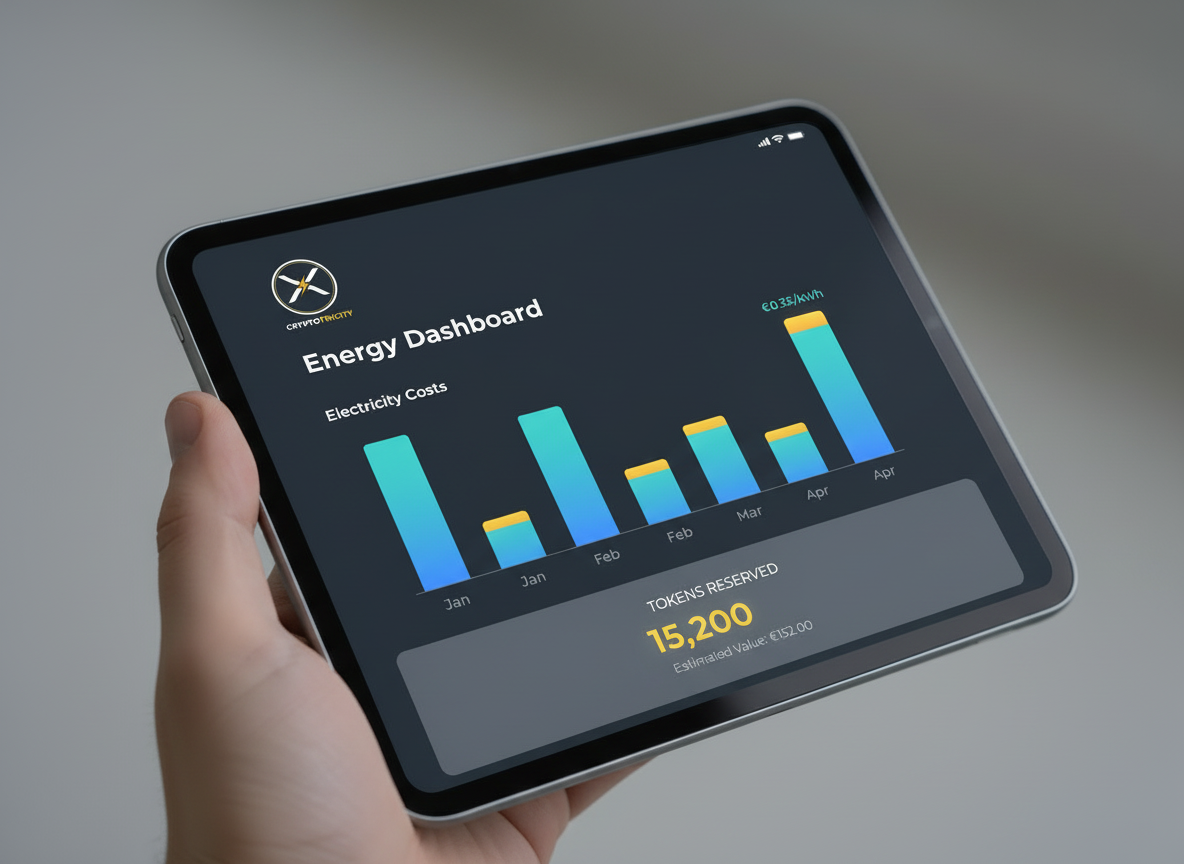
- Resident dashboard & evidence generation
- MEES compliance reporting output
- Real-time low-balance vulnerability detection
- Automatic emergency meter credit — no staff action
- Fuel poverty indicator logging
- Safeguarding evidence record per household
100 homes · 12 months · all-inclusive
+ VAT
What scaling costs — Phase 2 and beyond
The mobilisation fee does not repeat. From Phase 2 onwards you pay only the per-home annual charges on the expanded cohort.
| Phase | Homes | Annual per-home (ex VAT) | Annual total (ex VAT) | Mobilisation |
|---|---|---|---|---|
| Phase 1 — Pilot | 100 | £80 | £15,500 total | £7,500 one-time included |
| Phase 2 — Cluster Rollout | 500–1,000 | £80 | £40,000–£80,000 | No mobilisation fee — pilot framework reused |
| Phase 3 — Portfolio Intelligence | 2,000–5,000 | £70–£75 | £140,000–£375,000 | Volume rate — negotiated at contract |
| Phase 4 — Embedded Infrastructure | 5,000–10,000+ | £55–£65 | £275,000–£650,000+ | Full portfolio — enterprise terms |
| All fees exclusive of VAT at 20%. Resident DSR rewards funded by NESO — not included in above fees. Per-home charge covers platform, data, compliance and Lifeline only. | ||||
The MEES numbers.
Stated plainly.
| Scenario | ❌ Without Cryptotricity | ✓ With Cryptotricity |
|---|---|---|
| Smart readiness metric evidence | Manual collection. No automated baseline. High non-compliance risk on this metric. | Automated half-hourly DCC data. DSR participation records. Smart readiness evidence generated every month. |
| Warm Homes SHF application | Weak evidence base. Bids without consumption baselines are ranked lower or disqualified. | 12-month per-household evidence pack — baselines, DSR records, Lifeline log, bill credit data. Category-leading application. |
| Pre/post-retrofit benchmarking | Separate consultant engagement. Inconsistent methodology. Manual PAS2035 reporting. | Automated DCC baseline before works. Post-retrofit delta calculated automatically. DESNZ and PAS2035 compatible. |
| MEES fine exposure — 100 properties | Up to £30,000 per property = up to £3,000,000 aggregate liability | Pilot cost: £15,500 + VAT. Cost-to-risk ratio: 1:193. |

What your tenants
actually receive.
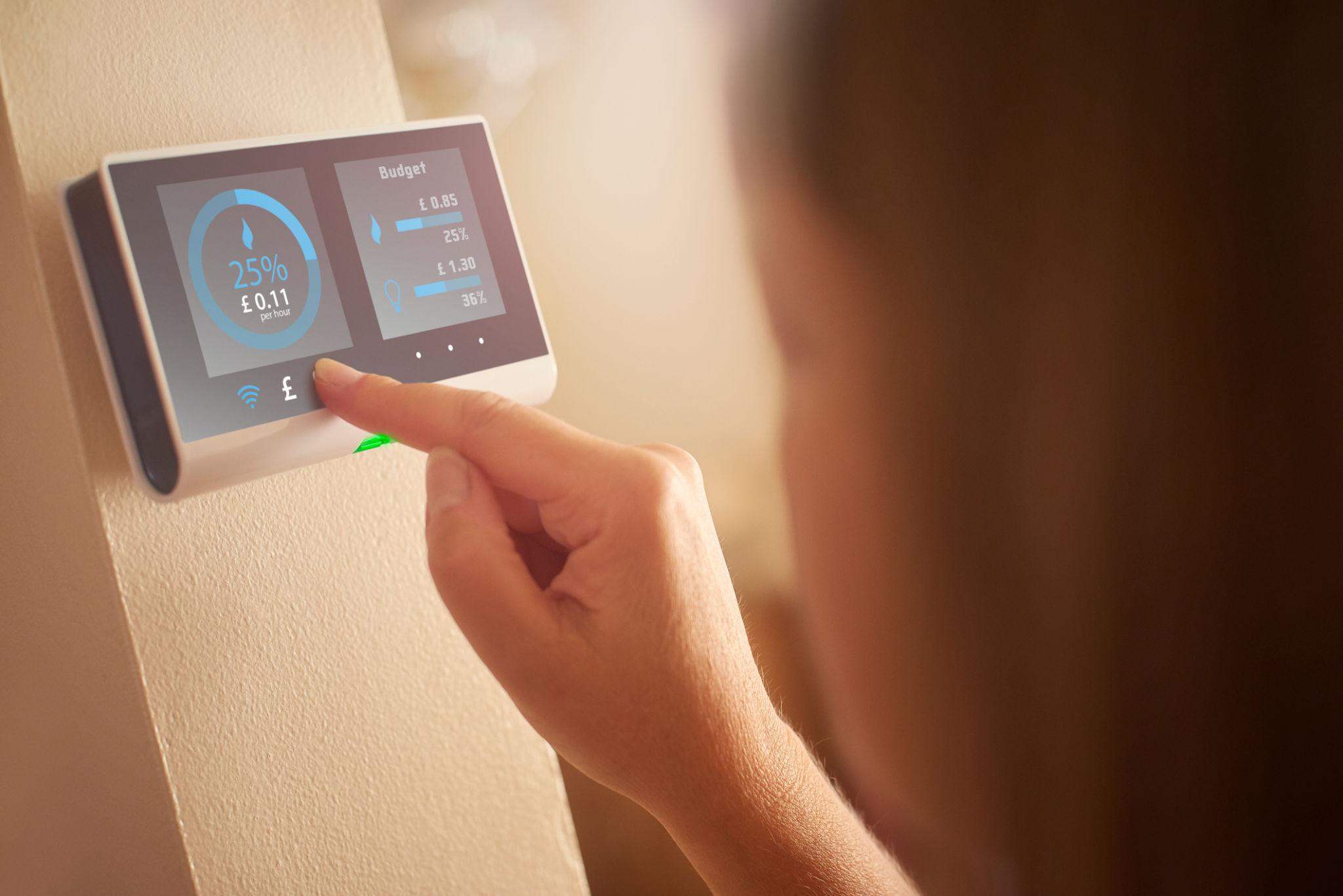
No tenant needs to understand energy technology. The platform is invisible — the only thing residents notice is a balance in pounds on a simple screen and, for prepayment meter households, a meter that never runs out.
When N3rgy detects a critically low meter balance, an emergency credit fires directly to the meter. No action by the tenant. No referral to your team. The lights stay on.
Zero action requiredNESO funds the reward directly — paid to Cryptotricity per flexibility event, converted to resident bill credits. Redeemable as a direct meter top-up. No cost to your organisation.
Optional participationCredits accumulate passively in the resident's dashboard balance. No action required. Builds toward structured discount tiers over time.
Zero action requiredAt Bronze tier a 3%–6% monthly energy bill discount activates. One tap to redeem accumulated credits. Applied directly to meter or energy account.
One-tap activationNot a pilot.
A four-phase journey.
Every component built during the pilot — consent workflows, DSR participation scoring, vulnerability thresholds, reporting templates — is reused directly in subsequent phases at no additional setup cost.
Establish proof of concept. Validate DSR participation. Create per-household baselines. Generate full annual evidence pack ready for MEES and Warm Homes Fund applications.
Scale participation. Deepen Warm Homes Fund evidence base. No mobilisation fee. Portfolio-level DSR revenue begins.
Identify where capital investment delivers most. Portfolio-wide MEES compliance evidence. Annual DSR income stream established.
Every property evidenced. Every vulnerable household protected. Continuous MEES compliance. Embedded Warm Homes delivery vehicle. Self-sustaining DSR income.

Five things that currently
cost more to produce manually.
Validated. Registered.
Government-engaged.
Built by people who have
lived the problem.
One conversation.
Eight weeks to live.
We are looking for one housing association to co-deliver the first resident-energy participation pilot in England. Three questions determine whether we can move forward.
If the answer to all three is yes — we can have tenants enrolled, baselines established, and the Lifeline active within eight weeks of agreement.
Request a 30-minute conversationmichael@cryptotricity.com