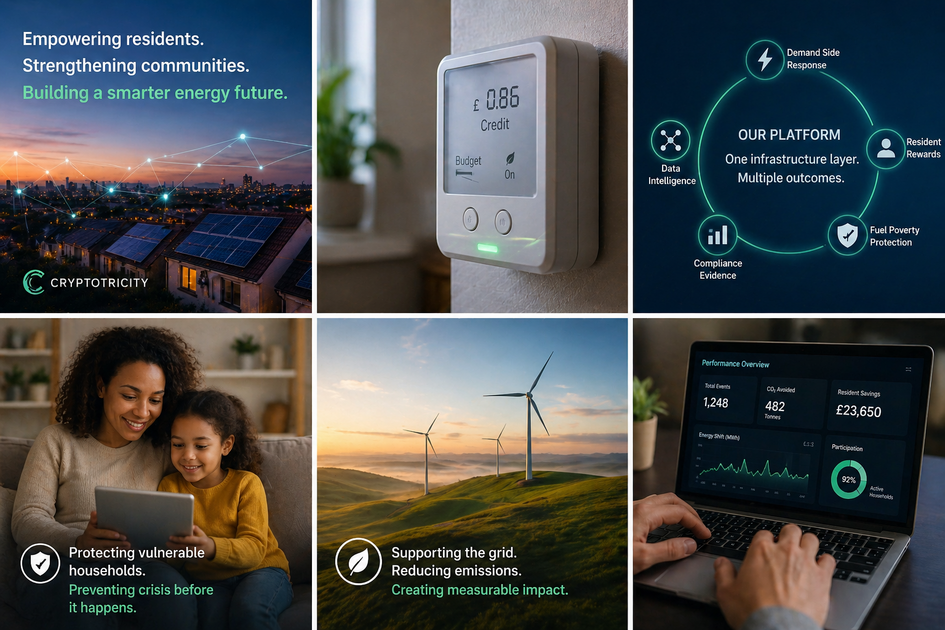
Housing associations, energy suppliers, and local authorities each have a distinct commercial proposition. The infrastructure is shared. The value is tailored to each buyer.
Housing associations pay a one-off connection fee. No SaaS. No pilot fee. No ongoing HA cost. Cryptotricity registers as the NESO DFS aggregator and splits settlement monthly with the HA as rent credits or service-charge credits.
“For 62p a month per home, we turn your tenant’s smart meter into a debt-recovery tool.”
New legislation confirmed January 2026 — HAs in scope for the first time. Smart readiness is the most likely compliance route for older stock. Cryptotricity generates verified DSR participation records automatically.
NESO DFS settlement returned monthly as rent or service-charge credits — via CSV compatible with Civica, MRI Housing, Capita, and Aareon.
The Lifeline mechanism fires an automatic micro-credit when balance falls below £10 — preventing disconnection. Every activation is a permanent XRP Ledger transaction.
| Tier | Homes | Connection Fee | CT Fee | HA Share |
|---|---|---|---|---|
| Tier 1 — Pilot | 1–1,000 | £7,500 + VAT | 55% | 45% |
| Tier 2 — Growth | 1,001–10,000 | £14,500 + VAT | 50% | 50% |
| Tier 3 — Enterprise | 10,001–20,000 | £27,500 + VAT | 45% | 55% |
| Strategic Anchor | 20,000+ | Bespoke | ~40% | ~60% |
| Homes | NESO Gross/Season | HA Share |
|---|---|---|
| 100 | £1,950 | £877 (45%) |
| 1,000 | £19,500 | £8,775 (45%) |
| 5,000 | £97,500 | £48,750 (50%) |
| 10,000 | £195,000 | £97,500 (50%) |
| 20,000 | £390,000 | £214,500 (55%) |
Working assumption £30/household/season at 65% participation. Source: NESO DFS Winter 2024/25 Performance Report.